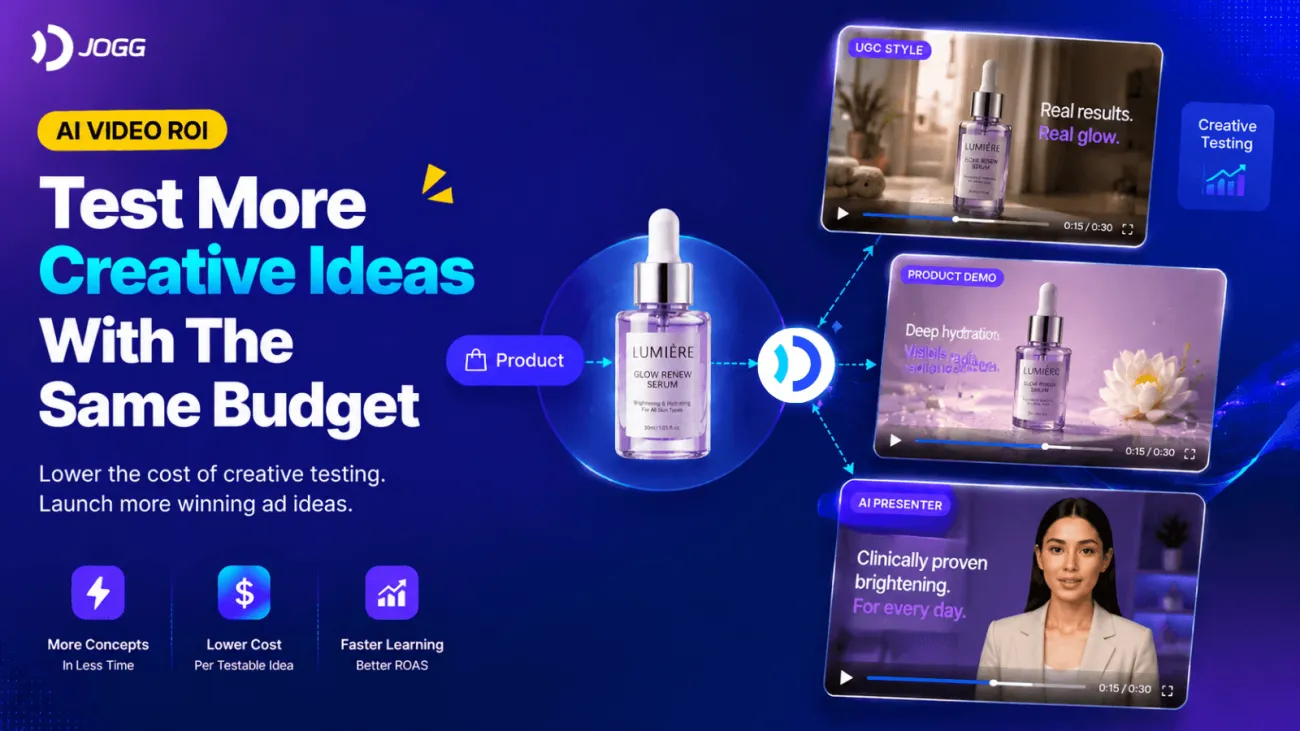

For ecommerce teams, the problem is rarely making one video. The problem is producing enough credible video concepts to keep campaigns moving.
A product launch needs demonstrations. A promotion needs a new offer led hook. A paid social winner needs fresh versions before performance drops. The same product may need different messages for first time buyers, returning customers, and retargeting audiences.
That creates a creative throughput problem. Teams need more testable messages, in more formats, without turning every iteration into a new production project.
This is where an AI assisted workflow can change the economics of creative production. The value is not simply a lower price per video. It is a lower cost and shorter path to test a new creative hypothesis.
Why “cost per video” is the wrong metric
When teams calculate video spend, they often start with the visible invoice: a creator fee, a studio day, or an editing retainer. That captures only one part of the cost.
Every new concept also creates work around the asset. Someone writes the brief. Someone gathers product information. Someone waits for footage, reviews a draft, requests revisions, and asks for new cuts for each placement. When the product, offer, or hook changes, the cycle begins again.
The result is familiar to most growth teams: they enter a campaign with fewer concepts than they wanted, then place too much media budget behind a small number of unvalidated messages.
The more useful question is:
- What does it cost our team to put one testable creative direction into market?
- What does it cost our team to put one testable creative direction into market?
A creative direction is more than a resized export. It is a distinct hypothesis: a different hook, benefit, objection, offer, audience, or presenter style. This is the unit a performance team needs to learn from.
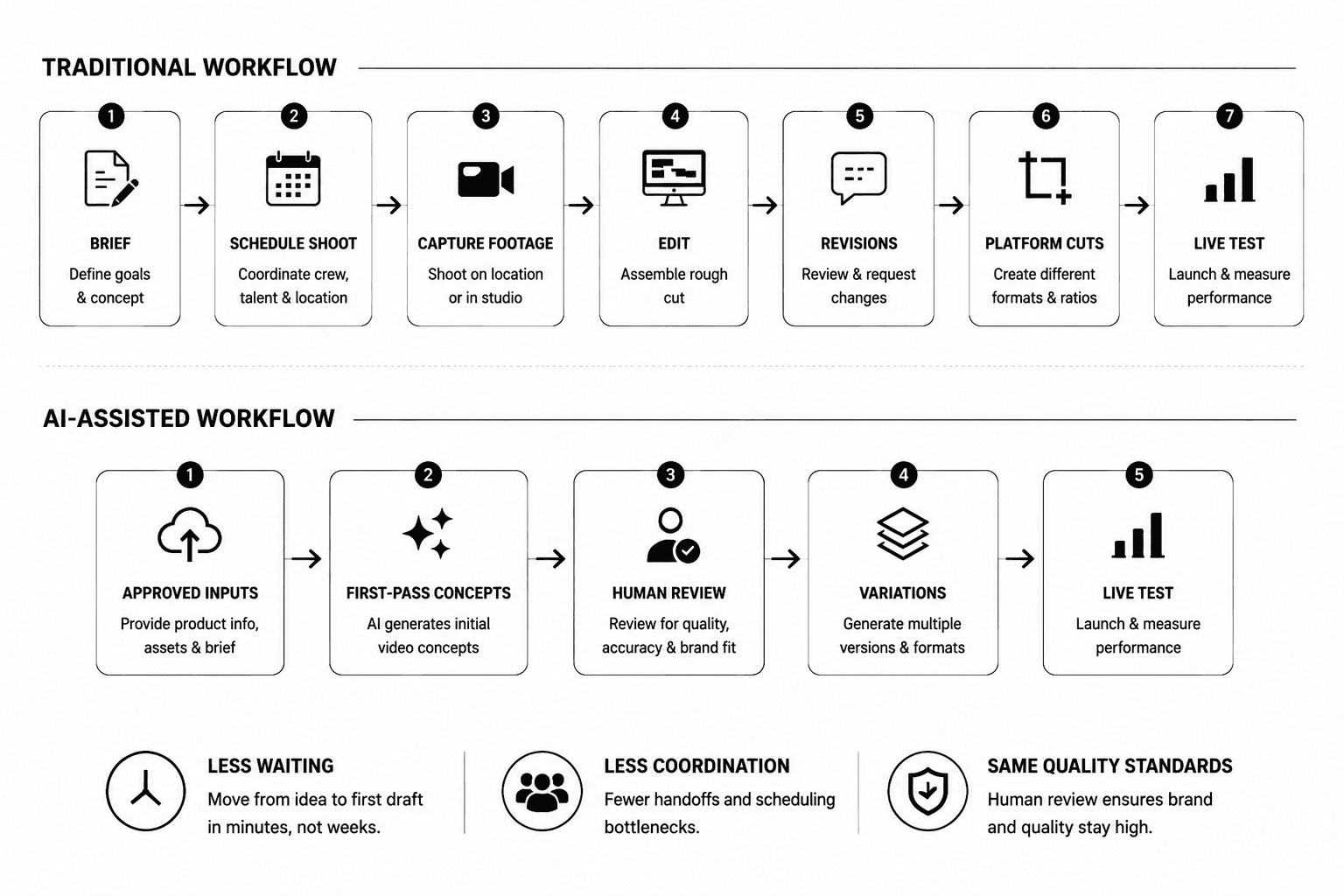
The costs that are easy to miss
Traditional production remains valuable for high-stakes brand campaigns, original live-action footage, and product moments that need a physical set.
It becomes less efficient when the same workflow is used for every routine variation.
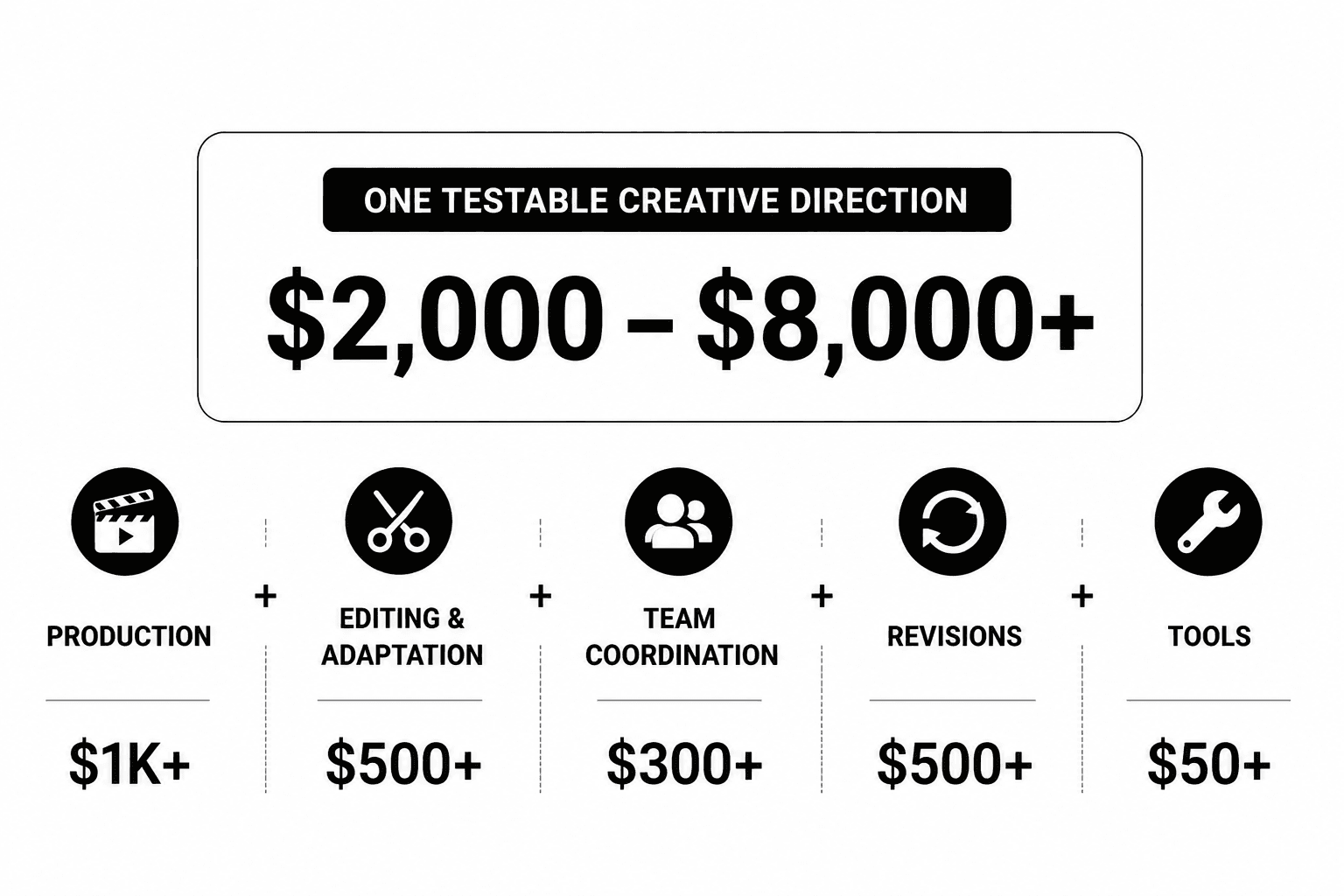
The True Cost of Producing One Testable Video Creative
| Cost category | Typical cost | What it means for ROI |
|---|---|---|
| Production | Creator fees, studio, talent, location, equipment | A single video can require thousands of dollars before knowing if the concept works |
| Post-production | Editing, motion graphics, subtitles, resizing, platform versions | Each new variation increases the cost of testing a different message or audience |
| Internal team time | Brief creation, feedback, approvals, project coordination | Marketing teams spend valuable hours managing production instead of testing new ideas |
| Iteration & revision | Reshoots, new cuts, updated offers, new hooks | Small changes can restart the production cycle and increase creative costs |
| Opportunity cost | Fewer creative concepts launched within the campaign window | Less testing means slower learning and more budget spent behind unproven ideas |
The final two rows matter most for performance marketing. A polished asset that arrives after the promotion ends is less useful than a good, on-brand asset that gives the team time to test, learn, and iterate.
A better way to evaluate AI video ROI
To evaluate an AI video workflow, track these four measures alongside direct production spend:
-
Creative throughput: How many distinct concepts does the team produce each month?
-
Cycle time: How long does it take to move from an approved brief to a reviewable draft?
3.Variation capacity: How many hooks, formats, offers, or audience angles can the team create from one product message?
4.Cost per testable direction: What does the team spend to produce, review, adapt, and launch one distinct message?
These measures move the discussion beyond “Can AI make a cheaper video?”
They ask whether the team can learn faster without adding coordination work or losing control over brand and product claims.
How JoggAI fits into a creative testing workflow
Based on the product workflows referenced in JoggAI’s product material, teams can begin with inputs they already own: product-page content, product images, approved copy, and scripts.
Workflows such as URL to Video, Text to Video, and PPT to Video can help teams turn those inputs into first-pass video concepts.AI Avatar or Custom Avatar workflows can support presenter-led formats when a message needs a human presence but does not justify a new recording session.
Product-focused workflows can support brands that need additional product-led creative for launches, catalog updates, or promotions.
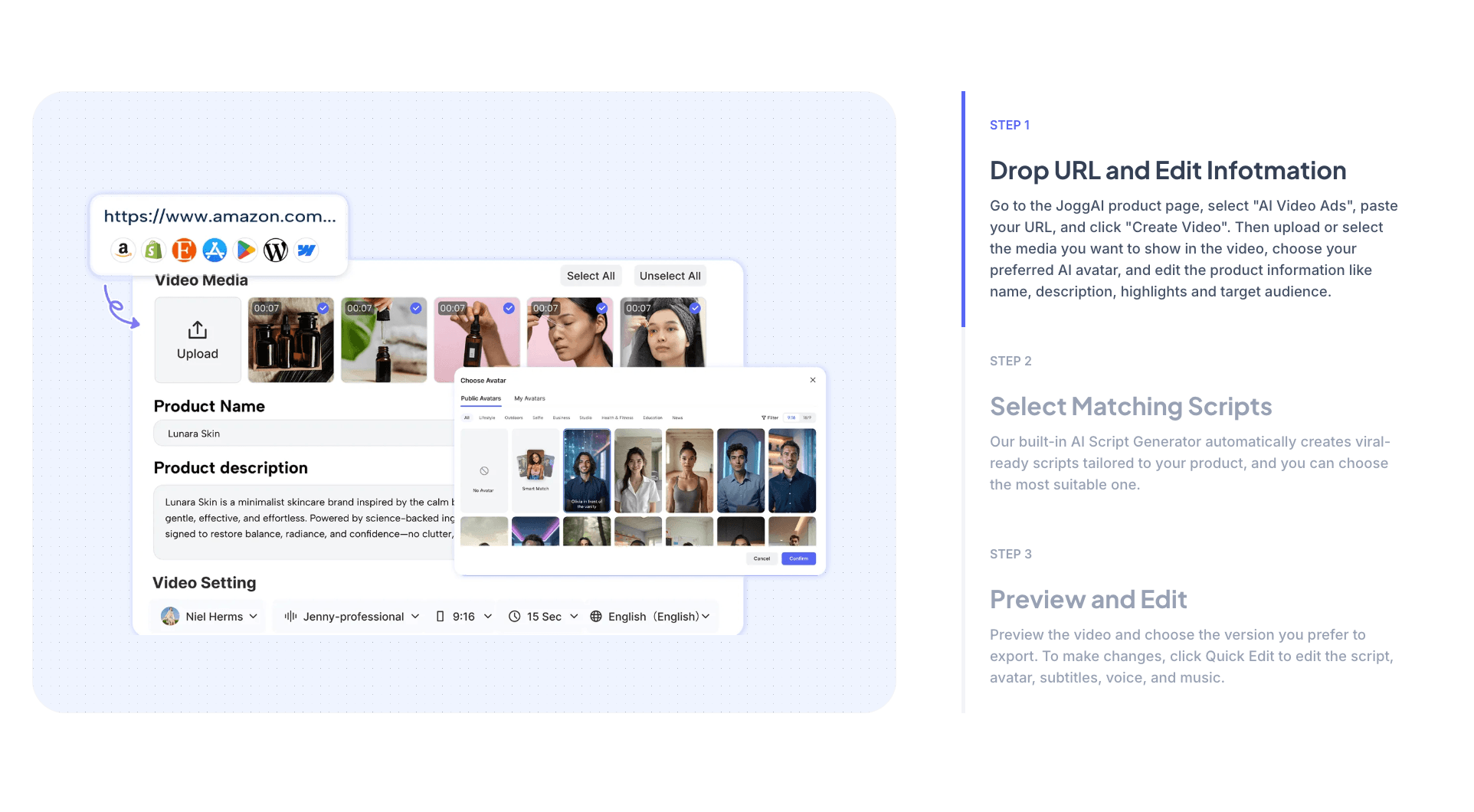
The important word is first-pass. The goal is not to remove the marketer from the process or publish unreviewed assets. The goal is to reduce the production work required before the team has something concrete to assess.
In practice, a sound workflow looks like this:
-
A marketer chooses the audience, offer, and message.
-
The team creates several first-pass concepts from approved inputs.
-
A reviewer checks claims, visuals, brand voice, and compliance.
-
The strongest concepts are adapted for the relevant placements.
-
Live performance informs the next creative round.
JoggAI accelerates the repeatable production layer. The team still owns strategy, approval, and quality.
Illustrative scenario: a lean DTC launch team
Imagine a three-person growth team preparing to launch a skincare product in two weeks.
The team has a product page, approved claims, 12 product images, an offer, and common customer objections gathered from reviews. It does not have time to coordinate several new creator shoots.
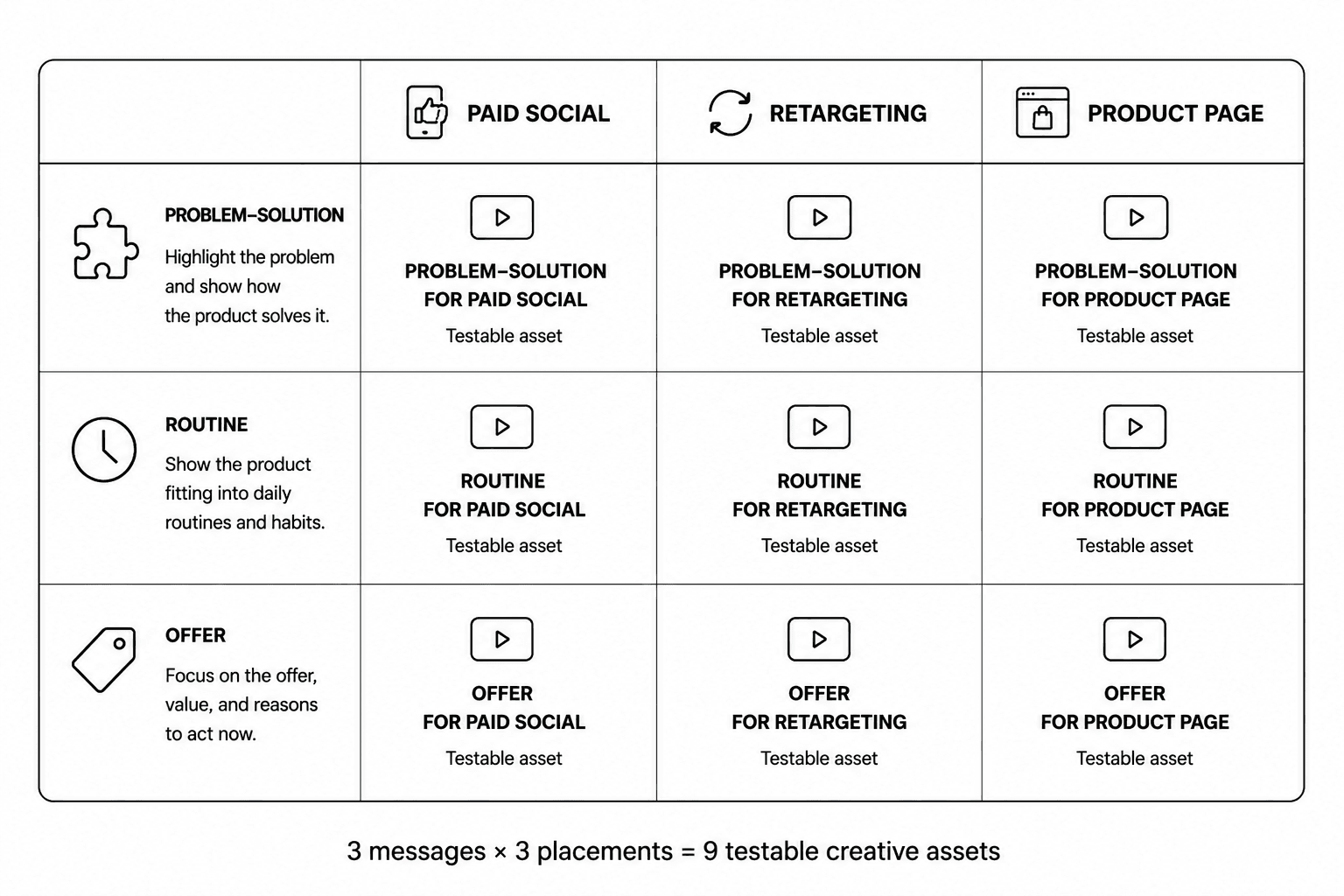
The campaign needs three distinct messages:
-
problem-solution hook
-
product-routine explanation
-
offer-led video
Each message also needs a vertical paid-social version, a shorter retargeting cut, and a product-page version. Before the campaign starts, that is nine assets and three creative hypotheses to review.
Under the team’s usual workflow, every new message adds briefing, creator coordination, editing, feedback, and exports. The team may therefore produce only one or two concepts, even though it has three messages worth testing.
With an JoggAI workflow, the team can use its approved product inputs to create first-pass versions of all three directions. The growth lead then reviews each concept against four questions:
-
Is the opening hook clear in the first few seconds?
-
Does the wording match approved product claims?
-
Does the visual treatment fit the brand and the intended placement?
-
Is the concept strong enough to deserve media budget or a higher-production version?
The outcome is not guaranteed to be a winning ad. The operational advantage is that the team can remove weak directions earlier and enter the campaign with more messages ready to learn from.
JoggAI Creative Production ROI Model
Example only. Replace with your team’s actual production costs, internal time, and JoggAI plan.
Assume a team produces 12 distinct video concepts and 24 platform or messaging adaptations per month.
| Monthly input | Traditional workflow | JoggAI workflow |
|---|---|---|
| 12 concepts | 12 x $650 = $7,800 | Generated from existing product assets using JoggAI video workflows |
| 24 adaptations | 24 x $125 = $3,000 | Included in JoggAI workflow (credit usage varies) |
| Internal coordination | 24 x $45 = $1,080 | 16 × $45 = $720 |
| Video tool plan | — | $399/month(800API credits) |
| Illustrative monthly total | $11,880 | $1,119 |
Illustrative ROI = ($11,880 - $1,119) / $1,119 = 962%
In this illustrative model, the estimated monthly workflow cost changes from $11,880 with traditional production to approximately $1,119 with a JoggAI-assisted workflow, excluding variable credit usage.
The value of this model is not the exact dollar amount. It shows how AI-assisted workflows can reduce production overhead by combining video generation, creative adaptation, and internal review into a more scalable process.
Your actual costs may vary depending on your production approach, JoggAI plan, credit usage, video settings, and internal team costs.
Start with a focused pilot, not a full replacement
JoggAI does not need to replace every shoot to be useful. Use traditional production when original footage creates strategic value. Use an AI-assisted workflow when the job requires repeated, product-led, variation-heavy content.
Start with one product and one active campaign. Choose three message angles. Before beginning, record your baseline for production spend, coordination hours, time to first draft, and the number of concepts that reach a live test. Run the same scope through an AI-assisted workflow and compare the two processes.
That pilot will tell you more than a generic “AI saves time” claim. It will show whether your team can turn existing product information into more testable creative with less production friction.